

Step-Up SIP: How a Yearly Increase Boosts Your Corpus

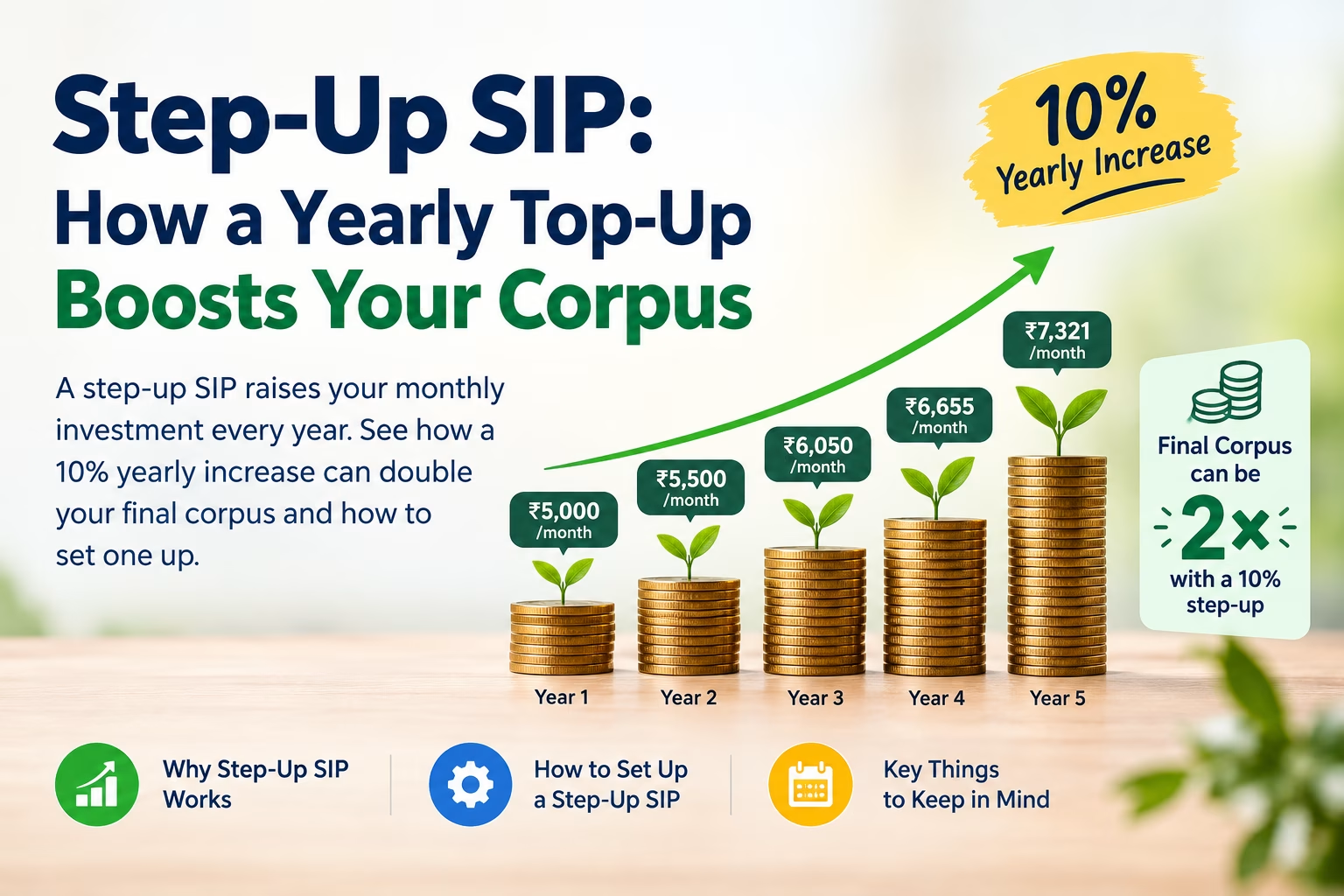
Your salary rarely stays the same for 20 years, so why should your investment? A step-up SIP (also called a top-up SIP) automatically increases your monthly SIP amount by a fixed percentage or a fixed rupee amount every year. It is one of the simplest ways to reach a big goal without starting with a big monthly amount.
How a step-up SIP works
You start with a base amount, say ₹10,000 a month, and choose a yearly increase – for example 10%. In year one you invest ₹10,000 a month, in year two ₹11,000, in year three ₹12,100 and so on. Most fund houses and investment platforms let you set this up once, so the increase happens automatically on the anniversary of your SIP.
You can usually choose either:
- A percentage step-up (5%, 10%, 15%) – grows with the SIP and suits people expecting regular salary hikes.
- A fixed rupee step-up (₹500 or ₹1,000 every year) – easier to predict and budget for.
The difference it makes: a worked example
Assume a 12% annual return and a 20-year horizon, starting at ₹10,000 a month:
| Plan | Total invested | Estimated corpus |
|---|---|---|
| Flat SIP of ₹10,000 | ₹24,00,000 | ₹99,91,479 |
| Step-up of 5% a year | ₹39,67,914 | ₹1,37,37,623 |
| Step-up of 10% a year | ₹68,73,000 | ₹1,98,88,715 |
With a 10% yearly step-up the corpus is roughly double the flat SIP. Part of that comes from investing more money, but a large part comes from compounding on those extra contributions. You can model your own numbers in the step-up SIP calculator.
Why step-up SIPs are so effective
They match your income curve
Most salaried people see their income rise over time. If your SIP stays flat, it shrinks as a share of your income – ₹10,000 might be 20% of your salary today and only 7% in fifteen years. A step-up keeps your savings rate steady or rising.
They fight inflation
With inflation around 5–6% a year, a flat ₹10,000 SIP buys less real wealth each year. A step-up of at least the inflation rate keeps your real contribution intact.
They make big goals reachable
If a goal needs ₹25,000 a month today, that may feel impossible. Starting at ₹12,000 with a 10–12% step-up can reach a similar corpus in the same time, while keeping the early years comfortable.
How to choose your step-up rate
- Look at your typical annual hike. If your salary usually rises 8–10%, a 5–10% step-up is sustainable.
- Keep it below your hike. That way part of every raise still goes to your lifestyle and the plan does not feel like a burden.
- Consider a cap. Some platforms let you set a maximum SIP amount; after that the SIP stays flat.
- Review every year. If income drops in a year, you can skip the step-up rather than stop the SIP entirely.
A real-life example
Consider Priya, 28, who earns ₹60,000 a month and wants to invest for retirement at 58. She can comfortably spare ₹8,000 a month today. A flat ₹8,000 SIP for 30 years at 12% would grow to roughly ₹2.8 crore – a good number, but one that will have lost most of its purchasing power by the time she retires.
If Priya instead adds a 10% step-up every year, her SIP reaches about ₹19,000 a month in year ten and about ₹49,000 in year twenty. Those later amounts are still a similar share of her growing salary, so the plan never feels painful, yet her projected corpus becomes roughly two and a half times as large – about ₹7 crore instead of ₹2.8 crore. The key insight is that she did not need to find ₹20,000 a month on day one – she only needed to commit to growing her SIP as her income grew.
Whatever your age, the same logic applies: start with what is comfortable, then let the step-up do the work.
Step-up SIP vs manually increasing your SIP
You can achieve the same effect by starting a new SIP every year, but the automatic option has two advantages: you do not have to remember, and you avoid the temptation to postpone the increase. Behaviour is the biggest driver of investment results, and automation removes decisions you might otherwise put off.
Things to keep in mind
- Each step-up instalment is a fresh purchase, so for ELSS funds each instalment has its own three-year lock-in.
- Returns are assumptions. Use a conservative rate (10–12% for diversified equity) when planning.
- Pair the step-up with a goal. Use the goal SIP planner to find the starting amount that reaches your target.
If you already run a SIP, adding a modest yearly step-up is probably the single highest-impact change you can make to your plan. It costs little today and can make a very large difference later.